Close-up or stage: which is right for my event?
Ask what the room is doing. Standing and talking wants close-up; seated and attentive wants stage. Booking the wrong one is the most common avoidable mistake in this category.
Matteo Cammisa
Founder, MAGIQ. Twenty years performing close-up and stage magic.
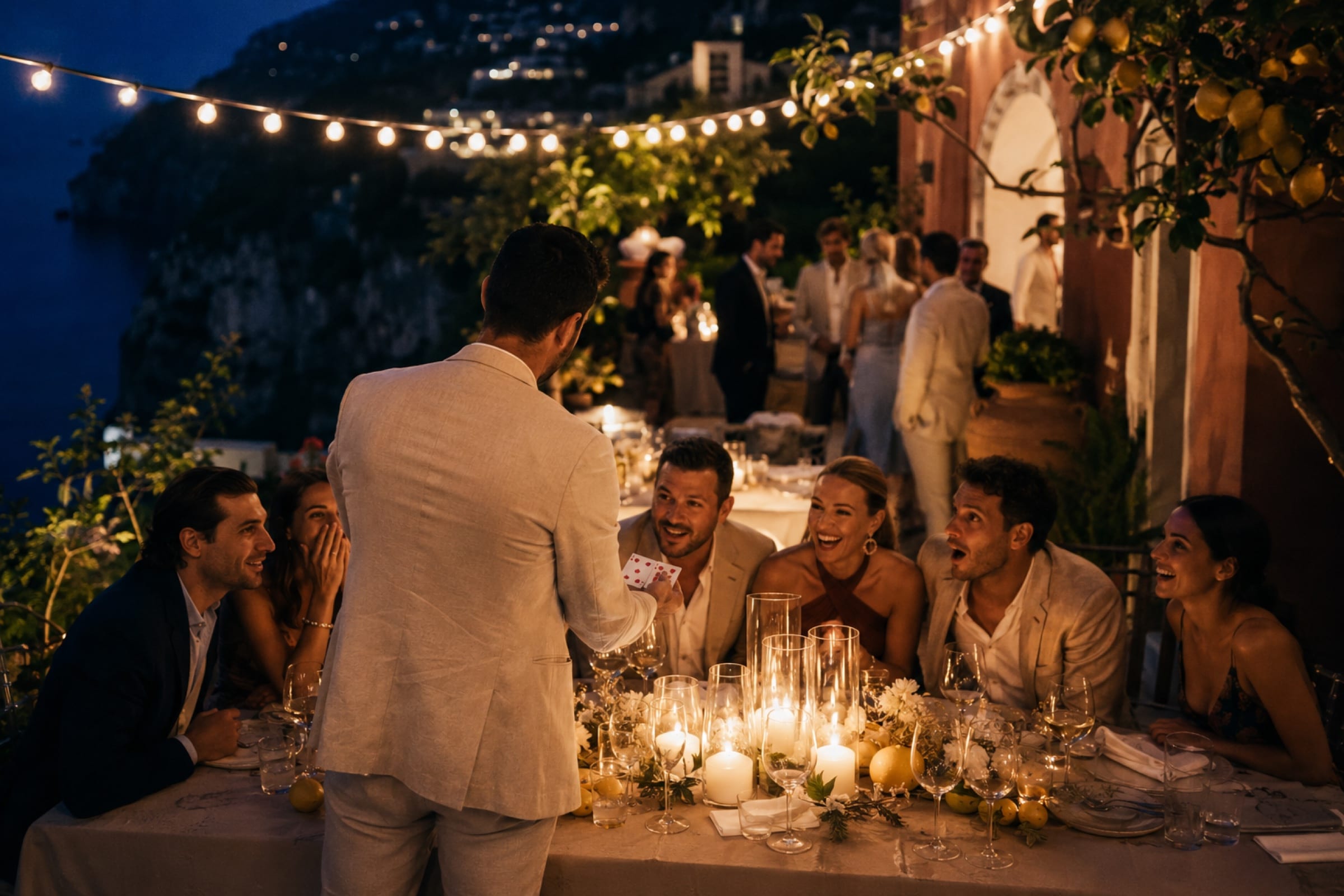
The question is not which is better. It is what your guests are physically doing during the twenty minutes you are booking, and the answer follows from that almost automatically.
The test
| If the room is… | Book… |
|---|---|
| Standing, holding drinks, not yet talking to each other | Close-up or walkaround |
| Seated at tables, between courses | Close-up, table to table |
| Seated and facing one direction, with a stage | A stage set |
| Seated, thirty to eighty people, no stage | Parlour — the format most buyers do not know exists |
| Moving through several rooms across an evening | Walkaround |
What close-up actually does
A performer works small groups at conversational distance, six to twelve people at a time, moving on after eight to fifteen minutes. Over a two-hour reception a strong one reaches most of a two-hundred-guest room without the evening ever stopping.
That last part is the real advantage. Nothing has to be announced, nobody has to sit down, and the room's own energy is used rather than interrupted.
What a stage set actually does
Fifteen to forty-five minutes in which the entire room shares the same experience at the same time. It is the only format that produces a collective moment, and that is worth a great deal when the evening needs one.
It also carries the most risk. It depends on sightlines, sound, lighting and a running order that will slip. A stage act in a badly lit ballroom with pillars is a wasted booking regardless of who is on stage.
Close-up uses the room's energy. A stage set asks the room to stop and give it theirs.
The option nobody offers you
Parlour sits between the two: performed standing, to thirty to eighty seated guests, with material built to read at ten metres — but needing no stage, no rig and no sound beyond a microphone.
For a private dining room, a members' club or a drawing room, it is very often the right answer, and buyers routinely assume they must choose between close-up and a full production because nobody mentioned it.
Or both
The most common shape for a long evening is close-up during arrival drinks to warm the room, then a short stage set after dinner as the held moment. Two performers, or one who genuinely does both — and fewer do than claim to.
How far in advance should I book entertainment?
Eight to twelve weeks for most events, six months for a fixed-date gala or wedding — and if you are inside two weeks, call rather than write, because the shortlist changes shape at that point.
Does a luxury wedding actually need entertainment?
Not always — and when it does, it is almost never a show. The job is the gaps: the drinks hour, the turn between ceremony and dinner, the lull the photographs are taken in.
What makes entertainment work in a luxury hotel?
Consistency, not brilliance. A guest who returns monthly judges the property on the weakest night they saw — so the residency performer's real skill is being excellent the ninth week, not the first.
Would you rather we did it?
Describe the event and we will apply this framework for you, with the reasoning written down and our fee quoted before any shortlist exists.